
Why You Should Consider a Metal Roof - Whether You’re in Florida or New England
Metal roofs are a long-lasting and weather-resistant option for homes in harsh climates like Florida and New England. They handle hurricane winds, heavy snow, and salt air corrosion better than traditional materials like asphalt shingles or tiles. While the upfront cost is higher, their durability (lasting 40–70 years), energy efficiency (reducing cooling costs by up to 25%), and minimal maintenance make them a smart investment for many homeowners.
Key Benefits:
Florida: Withstands winds up to 165 mph, resists salt corrosion (aluminum preferred), and lowers cooling costs.
New England: Sheds snow easily, prevents ice dams, and resists freeze-thaw damage.
Drawbacks: High initial cost, noise without proper insulation, and potential denting or scratches.
Metal roofs are ideal for coastal or snowy regions, long-term homeowners, and those seeking energy savings. However, they may not suit tight budgets or homes with complex roof designs.
Two Main Types of Metal Roofs: Standing Seam and Metal Shingles
Metal roofs generally fall into two categories: standing seam and metal shingles. Both are designed to handle the challenges of coastal climates. Let’s dive into the details of each, starting with the sleek and durable standing seam option.
Standing Seam Metal Roofs
Standing seam roofs are known for their long, vertical panels with raised seams that interlock from ridge to eave. Thanks to their concealed-fastener and floating clip design, they offer excellent water resistance and can handle thermal expansion during significant temperature changes without warping or loosening fasteners [8][6].
"Standing seam is a concealed-fastener system with raised seams that interlock. It provides superior water resistance and a clean modern look" [5].
These roofs are also built to withstand extreme weather, including hurricane-force winds ranging from 140 to 165 mphwhen installed correctly [4][3].
With their clean, vertical lines, standing seam roofs are a popular choice for modern farmhouses, coastal homes, and even commercial-style residences. They’re also ideal if you plan to install solar panels, as the mounting brackets can clamp directly onto the raised seams - no need to puncture the roof surface [4].
Metal Shingles
For a more textured and traditional look, metal shingles are a great option. These interlocking panels mimic classic materials like slate, clay tile, wood shakes, or even asphalt shingles. This makes them a favorite for historic neighborhoods in New England or Spanish-style homes in Florida, offering the durability of metal without an industrial appearance [5][8].
"Metal shingles and tiles offer the best of both worlds." - Fullcover Roofing [8]
Metal shingles require a roof pitch of at least 3:12, compared to standing seam roofs, which can work on slopes as low as 1/4:12 [7]. They also tend to show less visible damage from hail or falling branches, thanks to their stone granule coating, which acts as a protective layer [8]. However, because they have more seams and fastener points than standing seam roofs, proper installation and material selection - particularly aluminum for coastal areas - is essential [3][8].
Ultimately, the best choice comes down to matching the roof type to your home’s style, roof pitch, and exposure to coastal conditions.
Benefits of Metal Roofs in Florida and New England
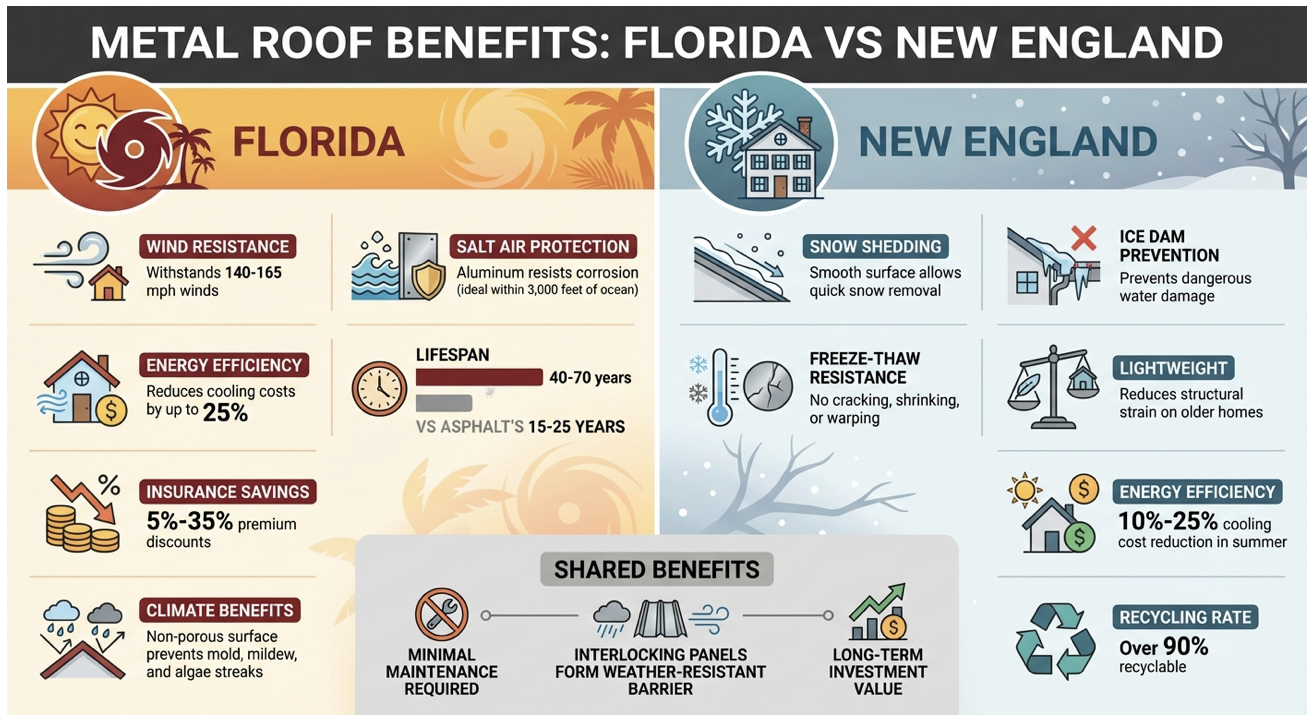
The benefits of a metal roof: Florida vs. New England
Homes in Florida and New England face very different weather challenges, and metal roofs are uniquely suited to tackle both. Whether it's Florida's intense heat and hurricane-force winds or New England's heavy snow and freeze-thaw cycles, metal roofing provides solutions tailored to these demanding climates.
Benefits for Florida Homes
Florida's weather is no joke - hurricanes, salt air, and scorching heat test the limits of any roofing material. Metal roofs, however, are designed to handle these conditions with ease.
Wind resistance is a top priority in Florida's hurricane zones. When installed correctly, metal roofs can endure winds ranging from 140 to 165 mph. Their interlocking panels form a continuous barrier that stands up to storms better than asphalt shingles [4][6][1][8].
Protection against salt air is vital for homes near the coast. Aluminum roofs are the go-to choice for properties within 3,000 feet of the ocean because they naturally resist corrosion from salt spray. Steel roofs, even with protective coatings, can deteriorate faster in these conditions.
"Aluminum is the gold standard for coastal Florida homes. Aluminum naturally resists salt corrosion, making it ideal for properties within 3,000 feet of saltwater." - FullCover Roofing [8]
Energy efficiency is another major perk. Metal roofs reflect solar heat instead of absorbing it, cutting cooling energy use by up to 25% compared to dark asphalt shingles [8]. Some homeowners have reported summer electric bills dropping by over $100 a month after switching to metal [4].
Metal roofs also combat Florida's humid climate. Their non-porous and quick-drying nature prevents issues like mold, mildew, and those unsightly black algae streaks that often plague asphalt roofs [8]. And with a lifespan of 40 to 70 years - far outlasting asphalt's 15 to 25 years - metal roofs require little maintenance beyond annual inspections of fasteners and sealants [4][6][1]. Plus, many Florida insurers offer premium discounts of 5% to 35% for homes with impact-resistant metal roofing [8].
For Florida's coastal homes, where traditional materials often fail under relentless environmental stress, metal roofs deliver durability, energy savings, and peace of mind.
Benefits for New England Homes
New England's winters bring their own set of challenges, and metal roofs are perfectly equipped to handle them.
Snow shedding is a standout feature. The smooth surface of metal roofs allows snow to slide off quickly, preventing dangerous accumulations [7]. When paired with proper insulation, air sealing, and attic ventilation, metal roofs also help avoid ice dams, which can lead to costly water damage [7].
Metal roofs are also resistant to freeze-thaw damage. Unlike asphalt or wood, metal doesn't crack, shrink, or warp during extreme temperature changes. Its non-porous surface prevents moisture absorption, eliminating the risk of rot, mildew, and moss growth during the winter thaw [4][9].
Another advantage is that metal roofs are lightweight, especially compared to materials like tile or concrete. This reduces the strain on a home's structure, which is particularly important for older New England homes with aging truss systems [9][10]. While asphalt shingles can lose granules or even blow off during winter storms, metal roofs interlock to form a durable, weather-resistant barrier [1].
In warmer months, reflective coatings on metal roofs can lower cooling costs by 10% to 25% [9][10]. Additionally, with a recycling rate of over 90%, metal roofs are an environmentally conscious choice [10]. Maintenance is minimal - no scraping moss or dealing with frequent repairs after harsh weather [4][9].
In New England’s coastal and snowy environments, metal roofs offer long-lasting value, combining resilience and low maintenance to meet the demands of harsh winters and variable weather conditions.
Downsides and Tradeoffs of Metal Roofs
Metal roofs come with their own set of challenges and considerations.
The upfront cost is steep. Metal roofing can cost anywhere from 2 to 4 times more than asphalt shingles. For a 2,000-square-foot home, asphalt shingles typically run between $8,000 and $15,000, while metal roofing can range from $18,000 to over $35,000 [1][4]. Standing seam systems, known for their concealed fasteners and labor-intensive installation, are the most expensive, often costing $8 to $35 per square foot installed [3][6]. While the long-term benefits may offset the cost, the initial investment is undeniably higher.
Noise can also be an issue. Without proper installation, rain or hail can sound much louder on a metal roof, especially if it's installed over open framing or bare decking. However, this can be mitigated by installing the roof over solid plywood or OSB sheathing, using a high-quality peel-and-stick underlayment, and ensuring the attic is well-insulated [4][8]. With these steps, a metal roof can be as quiet as asphalt shingles [4].
Denting and scratching are potential problems, particularly during severe weather. Hail or falling branches can damage thinner gauges or softer metals like aluminum. Even minor scratches can lead to faster corrosion [1][2]. Regular inspections are key to catching and addressing these issues early.
Thermal movement requires careful attention. Metal expands and contracts with temperature changes. If the fasteners, flashing, or seams aren't installed to handle this movement, it can lead to leaks, popped fasteners, or even creaking noises [8].
For coastal areas, material choice is crucial. Standard Galvalume steel doesn't hold up well in salty air and can corrode quickly. Aluminum is a better option for homes within 3,000 feet of the ocean because it naturally resists rust. Using stainless steel fasteners and occasionally rinsing the roof with freshwater to remove salt buildup can also extend its lifespan [4][7][8].
Being aware of these tradeoffs ensures that a metal roof can meet your home's needs, especially in demanding environments like coastal regions, while remaining a durable and effective long-term investment.
When Metal Roofs Make Sense: Florida and New England
Metal roofs aren’t a universal solution, but they shine in specific situations - especially in coastal areas where traditional roofing materials often fall short. Let’s dive into why metal roofing makes so much sense in places like Florida and New England.
When to Choose Metal in Florida
Florida’s unique climate comes with challenges like high winds, salt exposure, intense heat, and the need for durability. Metal roofs are engineered to handle these conditions, making them a smart choice for many homeowners.
For homes in hurricane-prone areas, metal roofs are built to withstand strong winds, offering dependable protection during storms. If your property is located within two miles of the ocean, salt spray can wreak havoc on typical roofing materials. Aluminum metal roofs, like those used in a recent Florida barrel tile project, resist rust and salt damage, providing a low-maintenance solution that lasts.
Florida’s relentless sun also demands energy-efficient roofing. Metal roofs with reflective coatings can cut cooling energy use by up to 25% [8]. And if you’re updating an older home with a Spanish or Mediterranean-style roofline, metal is a lighter, longer-lasting option that doesn’t require the structural reinforcements that heavier materials might need [1].
Another bonus? Impact-resistant metal roofs in Florida may qualify for insurance discounts, adding financial incentives to their practical benefits.
When to Choose Metal in New England
New England presents a different set of challenges, with its snowy winters and freeze-thaw cycles testing the limits of roofing materials. Here’s where metal roofs prove their worth.
For homes with steep roofs prone to ice dams, metal can be a game-changer. Its smooth surface helps snow and water slide off quickly, reducing the risk of ice buildup and leaks [5]. Of course, proper ventilation and underlayment are still essential for a well-functioning roof.
In areas with heavy snow, metal’s lightweight nature is a major advantage, especially for older homes. Unlike slate or tile, metal roofs reduce the strain on your home’s structure during harsh winters [5]. For historic homes in coastal towns like Gloucester or Rockport, metal shingles or stone-coated steel can replicate the look of traditional wood shakes or slate, blending seamlessly with period architecture while offering modern durability.
Coastal homes in New England also face salt exposure, making corrosion-resistant materials like aluminum or coated steel a must - especially within 3,000 feet of the ocean. And if you’re restoring a historic property, today’s metal roofing options can match traditional aesthetics while lasting anywhere from 40 to 70 years [3].
Whether it’s the hurricane winds of Florida or the snowy winters of New England, metal roofing provides tailored solutions to meet these regional challenges.
What to Consider Before Installing a Metal Roof
Opting for a metal roof involves more than just picking materials; it’s about ensuring your entire roofing system is designed for durability and efficiency. Elements like roof slope, ventilation, and material choice play a huge role in how well your metal roof performs over the years. Let’s dive into the key factors to consider, starting with roof pitch and complexity.
Roof Pitch and Complexity
The slope of your roof is a critical factor. For example, standing seam systems can handle low slopes (as shallow as 0.25:12), while metal shingles require a steeper pitch (minimum 3:12) to properly shed water. Roofs with complex designs, such as those featuring dormers or valleys, require extra care with flashing and must account for thermal expansion and contraction [7][6][8].
Steeper roofs, especially in areas like Florida with heavy rainfall or New England with snow-laden winters, help water and snow slide off more efficiently. This reduces risks like ponding or ice dams, which can lead to long-term damage.
In regions with extreme temperature swings, such as Florida’s scorching sun or New England’s frigid winters, your roof must handle expansion and contraction. Standing seam panels with concealed clips are particularly good at accommodating this movement, unlike exposed-fastener systems [6][8].
If you’re building a new home or planning an addition, simpler roof designs are often more resilient against hurricanes or heavy snow. On the other hand, complex roofs with multiple valleys can trap debris, which may eventually cause corrosion [7][8]. Alongside structural design, proper ventilation and insulation are key to ensuring your roof performs well in any climate.
Ventilation and Insulation
Good ventilation and insulation aren’t just about maintaining indoor comfort - they are essential for protecting your roof from moisture-related damage. In coastal or colder climates, condensation can form on the underside of metal panels, particularly at night. Adequate ventilation, whether through a vented attic or battens separating the decking and metal, helps prevent this moisture from corroding the metal or damaging the roof sheathing [7][5].
"In cold or subcooling conditions, condensation can form beneath metal roofing; install adequate venting - via a vented attic or battens - to prevent moisture damage." - Pacific Northwest National Laboratory (PNNL) [7]
In Florida, reflective metal roofs paired with proper insulation can cut cooling energy use by as much as 25% [8]. For homeowners in New England, combining airtight sealing, thick insulation, and effective ventilation helps prevent ice dams from forming along the roof’s edges [7]. Worried about noise from rain? With quality attic insulation and a peel-and-stick underlayment, metal roofs can be just as quiet as asphalt shingles [4].
Material Selection for Coastal Environments
When it comes to coastal areas, the right materials can make all the difference in minimizing maintenance and ensuring longevity. Aluminum is the go-to material for coastal installations because it naturally resists salt-air corrosion and doesn’t rust [8][3]. If your home is within 3,000 feet of the coastline, aluminum is typically the safest choice [8][7].
For inland properties, Galvalume steel - a steel core coated with a zinc-aluminum alloy - is a reliable option, though it’s more prone to edge corrosion in direct salt exposure [8][5]. Copper and zinc, which develop a protective patina over time, can last 75 to 100+ years even in harsh coastal conditions [8][5].
Using stainless steel fasteners and clips is non-negotiable for coastal installations, as they prevent premature failure caused by rust [7]. Additionally, finishes like Kynar 500® coatings are highly recommended, as they resist fading, chalking, and UV damage from the intense sun and salt spray [4]. To extend the life of your roof, homeowners in coastal areas should rinse their roofs with fresh water after major storms to remove salt residue [2][8].
Choosing a contractor experienced in coastal construction is equally important. The wrong materials or finishes can lead to expensive repairs, while the right choices ensure your roof stands strong for decades. These considerations lay the groundwork for a metal roof that thrives in coastal environments, delivering long-lasting peace of mind.
Decision Guide: Is Metal Roofing Right for Your Home?
Choosing the right roof for your home isn't a one-size-fits-all decision. Factors like your location, how long you plan to stay in your home, and your personal priorities all come into play. Here’s a closer look to help you determine if metal roofing is a good match for your situation.
Metal roofing could be a great choice if:
You live in a coastal area, especially within 1–2 miles of the ocean, and need a roof that can withstand salt air without corroding. Aluminum, for instance, is naturally resistant to rust and ideal for these environments [3].
Your home is in a hurricane-prone region where strong winds are a concern. Metal roofs offer excellent wind resistance and may even lead to lower insurance premiums [3].
You’re in New England and want to avoid the hassle of ice dams and heavy snow buildup. Metal roofs shed snow quickly, reducing winter-related risks [7].
You plan to stay in your home for the long haul and want a roof that won’t need replacing anytime soon. Metal roofs can last 40 to 70 years, far outlasting asphalt roofs, which typically last 15–25 years [3].
You’re looking for energy savings in a hot climate. Metal roofs reflect sunlight, which can help lower cooling costs over time [4].
You’re building or renovating a modern coastal home and want the sleek look of standing seam metal, or you’re updating a historic property where metal shingles can mimic traditional materials beautifully.
Your HOA allows metal roofing. Many modern metal roof designs meet aesthetic guidelines, but it’s always worth confirming first [4].
You might want to explore other roofing options if:
Your budget is tight and you need a roof immediately. While metal roofs save money over time, the upfront cost is significantly higher.
You’re planning to sell your home soon and may not have enough time to recoup the investment.
Your roof has a complex design with lots of valleys or dormers, which can make metal roof installation more expensive.
You live inland in a moderate climate without extreme weather. In these cases, a high-quality asphalt or composite roof might be more cost-effective.
You prefer a traditional style and live in a neighborhood where metal roofs are uncommon. While metal shingles can blend in, standing seam profiles might stand out too much for your taste.
This guide is designed to give you a quick overview before diving into more detailed consultations. If you’re considering a renovation in areas like New England or Florida, we’re here to help. We can walk you through your options based on your home’s unique needs, your timeline, and your long-term goals, ensuring you make the best decision for your property.
The Final Word
Metal roofing might not suit every home, but in regions like coastal Florida and New England, it addresses specific challenges head-on. From withstanding hurricane-force winds and heavy snow to resisting salt-air corrosion and preventing ice dams, a properly designed metal roof offers durability and reliability, lasting 40 to 70 years compared to asphalt's 15 to 25 years [3].
Yes, the initial investment is higher. Noise concerns call for proper underlayment, aluminum or marine-grade finishes are essential for coastal sites, and intricate roof designs can increase labor costs. However, for homeowners planning to stay put, the benefits often outweigh the expenses. These include reduced maintenance, potential insurance discounts ranging from 5% to 35%, and energy savings of up to 25% on cooling costs [8].
"A metal roof isn't just a cosmetic upgrade, it's peace of mind that pays for itself."
To maximize these advantages, the details matter. Choosing the right material for your coastal environment, ensuring proper ventilation and insulation, carefully detailing flashing around chimneys and valleys, and working with experienced metal roofing contractors are all crucial steps. With expert advice, you can make smart decisions that align with your home's needs.